
What Facebook Ads Actually Cost a Store (Hint: Not the CPM)
Facebook ads cost whatever you tell Meta to spend. There is no list price: you set a daily or lifetime budget, and the auction decides what each impression costs inside it. So the honest answer to “how much do Facebook ads cost” is a formula, not a range. For a store, the ceiling is the cost per purchase your gross margin can carry, and the floor is the weekly spend Meta needs before its delivery system stops guessing.
I read the pages ranking for this before writing it. They quote cost per click and cost per thousand impressions, list the factors that move them, and stop. None of them does the arithmetic a store owner actually needs: start from what one order is worth to you, and work backwards to a budget. That is what this post does. If you would rather hand the whole thing over, here is how I run Meta ads for Shopify brands.
On this page
- How much do Facebook ads cost?
- Why CPM is the wrong number to budget from
- What can I afford to pay for a sale?
- How much should I spend on Facebook ads a month?
- The costs that are not in Ads Manager
- Am I being overcharged for management?
- How do I know if it is working?
- Who should not pay someone to run this
How much do Facebook ads cost?
Facebook ads cost as little as a few dollars a day to switch on, and whatever your margin allows to run properly. Meta’s own budgets and costs page recommends a minimum daily budget of $5 and a budget that runs for at least seven days. That is the price of admission. It is not a budget that will sell anything reliably for a store, for a reason covered below.
What you pay per impression is set by an auction. You are bidding against every other advertiser who wants the same person’s attention on the same day, so the price moves with the season, the audience and how good your ad is. That is why every range you read online is wide, and why none of them tells you whether your account is healthy.
| What people quote | What it measures | Why it misleads a store |
|---|---|---|
| CPM | Cost per thousand impressions | Cheap impressions to the wrong people are the most expensive thing you can buy. |
| CPC | Cost per click on the ad | A click is not a customer. A low CPC on a curiosity ad can sit next to zero sales. |
| Cost per result | Whatever objective you picked | Only meaningful if the result is a purchase. Optimize for traffic and you get traffic. |
| Cost per purchase | Spend divided by orders | This is the one. Compare it to what an order is worth to you, and nothing else. |
Why CPM is the wrong number to budget from
CPM is the wrong number because it measures what Meta charges, not what you earn. An account can have rising CPMs and improving profit at the same time, if the ads are reaching people who buy. The reverse is common too: an owner celebrates a cheap CPM that came from a broad, low-intent audience, and the cost per purchase quietly doubles.
There is a second reason. Meta optimizes toward the event you tell it to. Choose traffic or engagement as the objective and the system will find the cheapest clicks and likes it can, which flatters every upstream metric. For a store, the objective should almost always be purchases, and the number you watch should be the cost of one.
If you only remember one thing: budget from your cost per purchase, and judge the account on the same number. Everything above it in the funnel is diagnosis, not the result.
What can I afford to pay for a sale?
You can afford to pay up to your gross profit on the first order for a new customer, and no more unless they reliably buy again. Gross profit here means order value minus product cost, shipping you pay, payment fees and any discount — the money left before marketing.
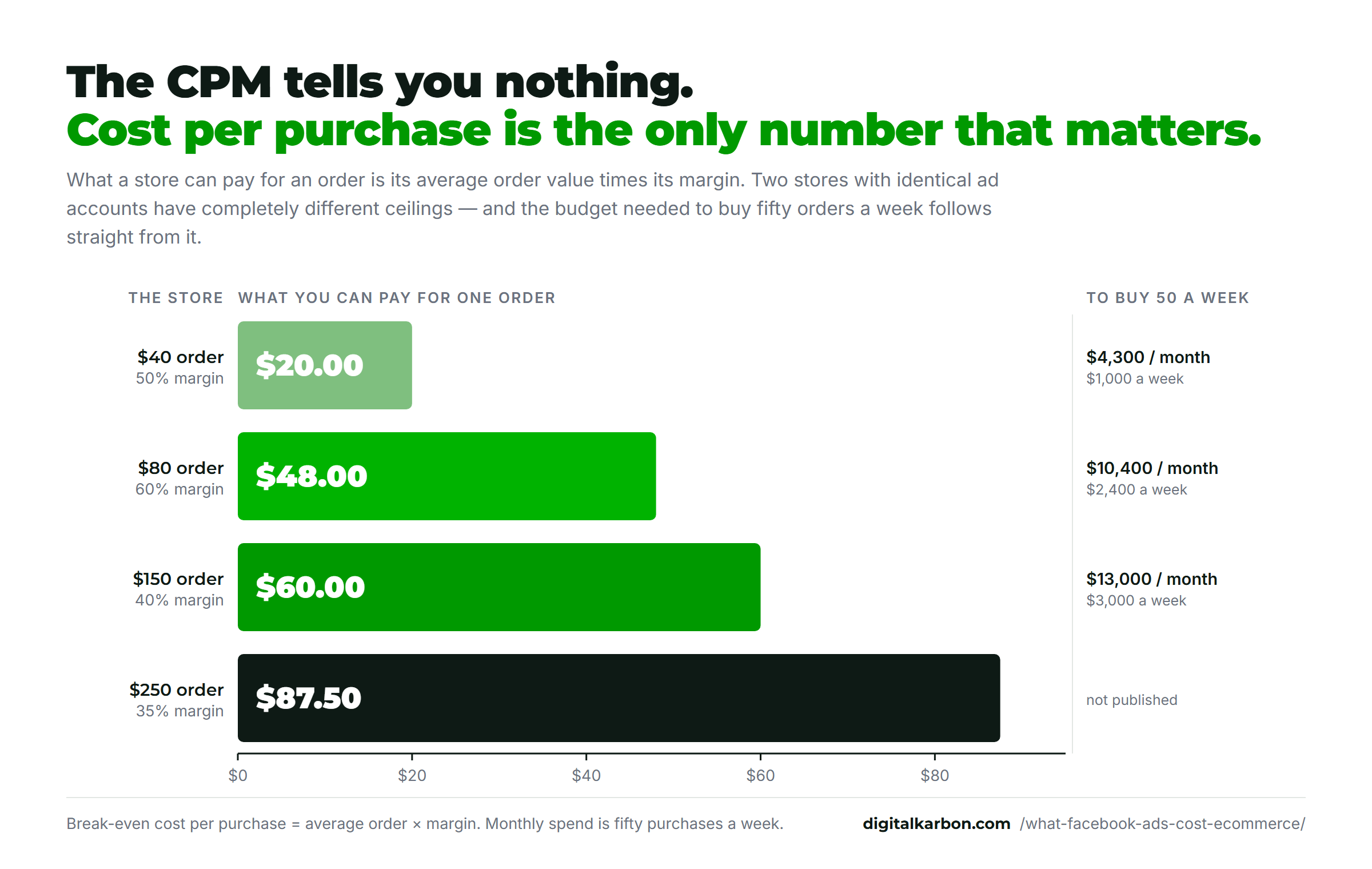
A worked example you can check. Say your average order is $80 and your gross margin after those costs is 60%. Each order leaves $48. That $48 is your break‑even cost per purchase: pay $48 for a sale and you have bought revenue at zero profit. Pay $30 and you keep $18. Pay $60 and every sale loses $12.
| Average order | Margin after costs | Break‑even cost per purchase |
|---|---|---|
| $40 | 50% | $20 |
| $80 | 60% | $48 |
| $150 | 40% | $60 |
| $250 | 35% | $87.50 |
Repeat purchase changes the ceiling, but only if you have the data. If your customers reliably buy a second time within a few months, you can pay more than first‑order profit and recover it later. If you are guessing at that, do not budget on it. I go through the full version of this calculation, including repeat revenue, in what a customer should cost an ecommerce store.
How much should I spend on Facebook ads a month?
Spend enough per ad set to get roughly 50 purchases a week, or accept that Meta will keep guessing. Meta calls the period after launch or after a significant edit the learning phase, and its own guidance is to structure ad sets to reach about 50 optimization events over seven days to get through it. Until then, delivery is less stable and the cost per purchase is usually worse.
That gives you the second half of the formula. Multiply your target cost per purchase by 50 and you have the weekly spend one ad set needs to learn on purchases.
| Target cost per purchase | Weekly spend for 50 purchases | Roughly per month |
|---|---|---|
| $20 | $1,000 | $4,300 |
| $48 | $2,400 | $10,400 |
| $60 | $3,000 | $13,000 |
The monthly column is the weekly figure times 52, divided by 12, rounded. Two things follow. First, most small stores cannot fund that for purchases on day one, and that is fine: the usual compromise is fewer ad sets, so the budget you do have is not split across five campaigns that each learn nothing. Second, a store with a high order value and a thin margin needs far more spend to learn than the headline ranges suggest, because each event is expensive.
Consolidate before you increase. Five ad sets at $20 a day each learn more slowly than one at $100, because each is trying to reach its 50 events alone.
The costs that are not in Ads Manager
The media spend is the only cost Meta shows you. It is not the only cost of running Facebook ads for a store.
- Creative. Meta’s delivery wears out ads. A store spending properly needs new images and video every few weeks, whether you shoot it, pay a creator or pay a designer.
- Management. Your own hours, or a fee to someone else. Your hours are not free just because they are not invoiced.
- Tracking. If the pixel and the Conversions API are not both sending purchases, Meta learns from a fraction of your sales and the cost per purchase it reports is wrong in both directions.
- Overspend on a given day. Meta’s pricing page says a daily budget can spend up to 75% more than the daily figure on some days, balanced across the week. Plan cash flow on the weekly number, not the daily one.
Am I being overcharged for management?
You are overcharged when the fee is a large share of spend and the fee structure rewards something other than your profit. There are three common ways people charge for running Meta ads, and each one pays for a different behavior.
| Pricing model | What it rewards | Where it goes wrong |
|---|---|---|
| Percentage of ad spend | Spending more | The manager earns more when your budget rises, whether or not the extra spend was profitable. |
| Flat monthly fee | Keeping the account | Stable and predictable. Can drift into maintenance if nobody is measuring the work. |
| Performance share | Whatever metric is shared | Only as good as the metric. Paid on platform‑reported revenue, it rewards over‑attribution. |
I charge a flat fee: $1,500 a month for one channel, with a $5,000 monthly ad spend minimum, published on the Meta ads page. The arithmetic behind the minimum is simple. At $5,000 of spend that fee is 30% of the media budget. Below that the fee is a larger share still, and the work cannot plausibly earn it back. For a wider comparison of fee models across channels, see what PPC management should cost.
How do I know if it is working?
It is working when your cost per purchase sits below your break‑even figure and your store’s total revenue moves with the spend. Check both, because Meta’s reporting counts sales it influenced under its own attribution rules, and those rules are generous to Meta.
- Take the last 30 days of Meta spend and divide it by the purchases Meta reports. Compare that to your break‑even cost per purchase from the table above.
- Look at total Shopify orders over the same period, not just the ones Meta claims. If Meta reports more orders than your new‑customer count went up by, some of what it claims would have happened anyway.
- Change one thing at a time. If you double the budget and the cost per purchase holds, the account has room. If it jumps, you have found the ceiling of that audience or that creative.
If you want an outside read on an existing account before spending more, a Facebook ads audit checks tracking, structure and creative against exactly these numbers. And if you are still choosing where to put the first dollar, Google Ads vs Meta Ads for ecommerce covers which channel usually goes first for a store.
Who should not pay someone to run this
If you cannot yet fund enough weekly spend to reach purchase volume on even one ad set, do not pay a manager. Run one campaign yourself, optimized for purchases, with one or two ad sets, and spend your money on creative instead. The same goes for a store that has not worked out its margin: no manager can hit a target you have not set.
Paying for management starts to make sense when the monthly spend is large enough that a small improvement in cost per purchase is worth more than the fee, and when you have enough purchases each week that changes can be measured rather than guessed at.
Questions people ask
How much do Facebook ads cost per month?
How much does it cost to run Facebook ads for a small business?
What is a good cost per result on Facebook ads?
Is $5 a day enough for Facebook ads?
Want this run properly?
I am Greg Asuncion, an ecommerce paid media consultant. I run Google Ads, Meta, Amazon and Microsoft for direct‑to‑consumer brands on Shopify — one person, published pricing, and a free audit after a call. Here is how I run Meta ads for Shopify brands.