
Is Google Ads Worth It? The Math for a Shopify Store
Divide one by your gross margin. If forty cents of every dollar you take is still yours after the product, the shipping and the card fee, then one divided by 0.40 is 2.5, and 2.5 is the return on ad spend — revenue divided by what you paid for it — that Google Ads has to beat before it has made you a single dollar. Everything below 2.5 is you buying revenue at a loss. That is the whole answer, and it takes about two minutes.
I went and read the pages currently ranking for this question before writing. Every one of them answers it for a business that sells leads: cost per lead, close rate, sales process, lifetime value of a client. That is a different business from yours. A store does not have a close rate. It has a margin, an order value and a conversion rate, and those three numbers settle the question without an opinion from anybody. Here is the arithmetic, the check that tells you whether an account already running is lying to you, and the cases where the honest answer is no. If you would rather hand the whole thing over, this is how I run Google Ads for ecommerce brands.
On this page
- Is Google Ads worth it for an ecommerce store?
- What ROAS do you actually have to beat?
- The same number in dollars, per order
- Why does a new Google Ads account look better than it is?
- What does it cost to find out?
- Who should not run Google Ads?
- What does it cost to have someone run it?
- How do I know if it’s working?
- How long before I see anything?
Is Google Ads worth it for an ecommerce store?
It is worth it when your gross margin is high enough that the return you can realistically get clears your break‑even, and it is not worth it when it is not. No amount of management skill moves a 20% margin store into profit on cold traffic, and a 70% margin store can survive campaigns that are run badly. For a sense of the spread: across the same 24 months The Lifeguard Store returned 17.5x blended and Shurhold returned 3.6x. Both are good businesses. The difference is margin structure, not management — which is why the number to beat is yours, not a benchmark. Whatever it is, it is only as honest as the measurement behind it, so check yours against Google’s conversion tracking documentation.
That sounds glib, so here is why it is the actual answer rather than a dodge. Google Ads is not a growth strategy, it is a price. You pay a fixed amount of money for a quantity of people who typed something into a search box. Whether that is a good trade depends entirely on what you keep from each order they place. The platform is the same for everybody. The margin is not, which is why one store swears by Google Ads and the store next to it lost money on the same campaign type.
Gross margin here means what is left of a sale after the cost of the product, the shipping you pay, the packaging and the payment processing fee — before rent, salaries or software. If you have never worked it out, do that before reading any further. Nothing else on this page is usable without it.
What ROAS do you actually have to beat?
Break‑even ROAS is one divided by your gross margin, expressed as a decimal. That is the whole formula. At a 40% margin you need 2.5. At a 25% margin you need 4.0, which almost nothing on cold traffic delivers.
| Gross margin | Break‑even ROAS | What that means in practice |
|---|---|---|
| 25% | 4.0 | Four dollars back for every dollar in, just to stand still. Achievable on branded search and almost nowhere else. Fix the margin before you fix the ads. |
| 30% | 3.3 | Hard. Possible on high‑intent product searches with a good feed, rarely on broad campaigns. |
| 40% | 2.5 | The common case for a store that buys wholesale. Realistic, but there is no room for a badly structured account. |
| 50% | 2.0 | Comfortable. Two dollars back per dollar in is a number a well‑run Shopping campaign can hold. |
| 60% | 1.7 | You can absorb mistakes, test more, and bid on terms a thinner store cannot touch. |
| 70% | 1.4 | Typical of a brand that makes its own product. At this margin the question is not whether Google Ads works, it is how fast you can scale it. |
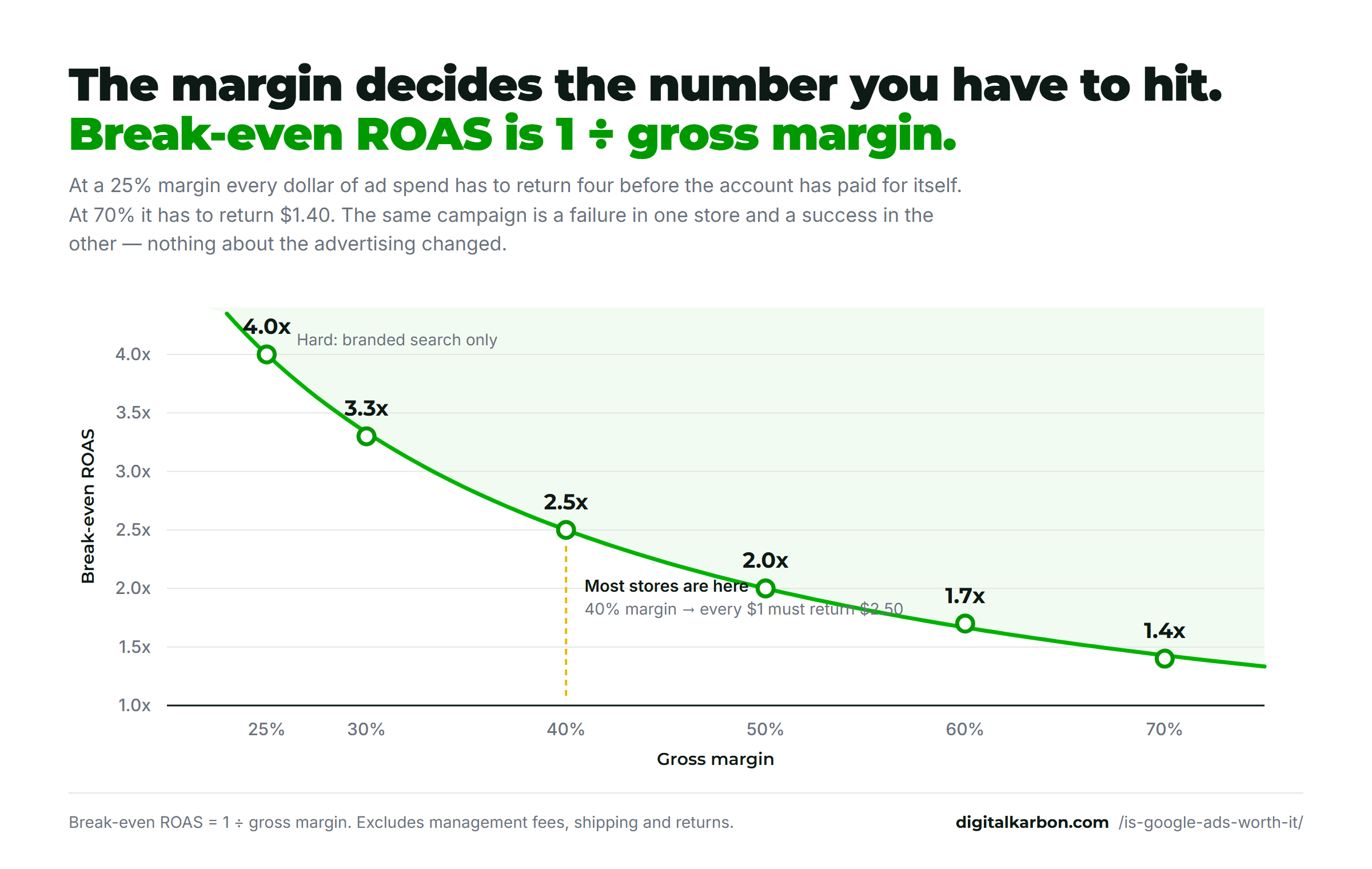
Check the arithmetic yourself: 1 divided by 0.40 is 2.5, 1 divided by 0.25 is 4. The table is just that division done six times. Now go into your ad account, look at the return on ad spend it is reporting, and put it next to your row. If the reported number is below your break‑even, the account is converting your inventory into somebody else’s revenue.
Two adjustments before you trust the comparison. Returns come off the top — if one order in ten comes back, your effective margin is lower than your spreadsheet says. And if a meaningful share of customers buy again without being advertised to, your break‑even on the first order is genuinely lower than the table. That second one is the legitimate reason to accept a losing first sale, and it is also the excuse every unprofitable account reaches for. The test is whether you can point at repeat purchase data, not whether it feels true.
The same number in dollars, per order
Cost per order is your cost per click divided by your conversion rate, and comparing it to your gross profit per order tells you the answer in money rather than in ratios. Some people find this version easier to argue with.
Take an $80 order at a 45% margin. Gross profit is $36, so $36 is the most you can pay to acquire that order before you are losing money. Now say clicks cost $1.50 and two in every hundred visitors buy. Cost per order is $1.50 divided by 0.02, which is $75. You are paying $75 to make $36. Every order loses $39, and more orders make it worse rather than better.
That example is the single most common shape of a failing ecommerce account, and it is also why “it is not working, let me increase the budget” is such an expensive instinct. There are only two ways out of it, and both are visible in the arithmetic:
- Pay less per click. $36 of gross profit at a 2% conversion rate means clicks have to cost $0.72 or less to break even — that is 36 multiplied by 0.02. Cheaper clicks come from more specific queries, better feed data and a tighter keyword set, not from lowering a bid until the campaign stops serving.
- Convert more of the clicks you already pay for. At $1.50 a click you need 4.17% of visitors to buy to break even — that is 1.50 divided by 36. Doubling a conversion rate from 2% to 4% is hard, but it is a known kind of hard: page speed, product photography, shipping cost shown early, and the landing page matching what the person searched for.
Neither of those is a Google Ads setting. The platform decides the price of the auction. You decide almost everything else, which is why two accounts spending the same money on the same products return different numbers. More on where that money actually goes in what Google Ads costs for a Shopify store.
Why does a new Google Ads account look better than it is?
Because it is buying customers who were already coming to you. The first campaign most stores turn on captures people typing the brand name into Google, those people convert at a far higher rate than strangers, and the blended return looks excellent while the campaign is mostly charging you for traffic you had for free.
This is the check the ranking pages leave out entirely, and it is the one that changes decisions. Open the search terms report, filter for your brand name and any misspelling of it, and look at what share of the account’s conversions and revenue sit in that filter. Then look at the rest. The rest is the part that is actually growing the business, and it is the only part whose return should be compared against the table above.
Branded search is not worthless — defending your own name against competitors bidding on it is a real job, and organic listings do not always hold the top of the page. The mistake is counting it as acquisition. Report the two separately from the first week and the question “is this working” gets much easier to answer honestly.
Performance Max makes this harder on purpose, because it will happily serve against your own brand queries and fold the result into one campaign number. If you run it, use brand exclusions so you can see the two halves apart. An account that cannot separate them cannot tell you whether Google Ads is worth it, only whether your brand is.
What does it cost to find out?
Enough spend to produce enough orders to read, which you can calculate rather than guess. I want at least thirty orders before I believe a number, because below that a single refund or one unusually large basket moves the result more than the campaign does.
So take your break‑even cost per order and multiply by thirty. Using the $36 figure from above, that is $1,080 of spend to get a readable answer if the campaign performs exactly at break‑even. A campaign that is doing better needs less; one that is doing worse needs more, and will also be telling you something before it gets there. That is the budget conversation, and it is specific to your margin rather than a number somebody read in a blog post.
Spend it on the narrowest, highest‑intent inventory you have — Shopping on your best‑selling products, or search terms that name the product rather than the category. A test that spreads a small budget across broad keywords produces no orders and no information, and the conclusion people draw from it is “Google Ads does not work for a store like mine” rather than “that test could not have worked”.
Who should not run Google Ads?
Four cases, and I would rather say this now than take the money and explain it in month three.
- Your gross margin is under 30% and you have no repeat purchase. The break‑even is above what cold traffic realistically returns. Work on cost of goods, price or the product mix first. Ads will not rescue the arithmetic, they will make the loss bigger and faster.
- Nobody is searching for what you sell. Google Ads harvests existing demand. If the thing you make is genuinely new, there is no search volume to buy and the money belongs on a channel that creates demand rather than intercepting it.
- Your site does not convert the traffic it already has. If organic and email visitors are not buying, paid visitors will not either, and you will pay for the privilege of learning that. Fix the conversion rate on free traffic first — it is the same work and it costs nothing per visit.
- You need the money back this month. Accounts take time to gather data, and the first weeks are usually the worst weeks. If the cash cannot survive that, it is not a bad channel, it is a bad moment.
There is a fifth that applies to hiring rather than to the channel: if you are spending under a few thousand a month, paying somebody a retainer to manage it can cost more than the waste they remove. At that level the honest advice is usually to run it yourself for a while and read the search terms report every week.
What does it cost to have someone run it?
Four pricing models exist, and each one quietly pushes the person you hire in a particular direction. Knowing which direction is most of what you need to choose between them.
| Model | How it works | What it incentivises |
|---|---|---|
| Percentage of ad spend | A fixed share of whatever goes through the account, usually billed monthly. | Spending more. The incentive lines up with your interests only while scaling is the right answer, and separates the moment it is not. Ask what happens to the fee when the correct move is to cut budget. |
| Flat monthly fee | A set amount regardless of spend. | Efficiency, and also doing the minimum that keeps you from leaving. Neutral on budget, which is its main virtue. Ask what is actually included each month. |
| Hourly | Billed for time worked. | Hours. Fine for a defined project such as an audit or a rebuild, poor for ongoing management, where the best months are the ones that need the least work. |
| Performance or commission | A share of revenue or of profit above a threshold. | Claiming credit. Attribution decides the invoice, which makes every reporting argument a financial one. Works when the threshold is agreed in advance and the tracking is not controlled by the person being paid. |
I publish what I charge on the site rather than quoting per prospect, and the model is a flat monthly fee for exactly the reason in row two: it is the only one of the four that does not make me want something other than what you want. The wider version of this decision — hire in, hire an agency, hire one person — is in in‑house versus agency versus consultant.
How do I know if it’s working?
Compare the reported return against your break‑even row, with branded search taken out, over a period long enough to contain thirty orders. If non‑brand return is above break‑even, it is working. If it is below, it is not, whatever the dashboard headline says.
The traps in that sentence are worth naming, because all three are common:
- The platform counts conversions it influenced, not only ones it caused. A customer who saw an ad, left, then came back through email is credited to the ad. Put the ad platform’s revenue next to the revenue in your Shopify admin for the same dates. The gap is the size of the disagreement you need to hold in your head.
- Return on ad spend does not include the management fee. Add it in. A 3.0 that becomes a 2.6 once the fee is counted is a different decision at a 40% margin.
- A rising return with falling revenue is not an improvement. It usually means spend was cut back to the easiest traffic. Watch total profit, not the ratio alone.
If you want the same measurement done across every channel rather than inside one ad account, the unit to work in is customer acquisition cost, which has the advantage of being a number your accountant also recognises.
How long before I see anything?
Days for traffic, a few weeks before the numbers mean anything. Ads can serve within hours of approval, which is the genuine advantage of paid search over everything else, but the first reading you should act on is the one taken after roughly thirty orders.
Resist judging week one. Early data on a new campaign is dominated by queries you have not excluded yet and by learning periods on automated bidding, and the honest description of that fortnight is that you are paying for the information. What you should see inside two weeks is not profit but direction: whether the search terms coming through are the ones you intended to buy, and whether the click prices are anywhere near the number the arithmetic allows.
If both of those look wrong at the end of a fortnight, the problem is structural rather than one of patience, and waiting another month will only make the invoice larger. That is the point at which an audit is cheaper than persistence — more on that across everything I write about Google Ads for ecommerce.
Questions people ask
Are Google Ads worth it for a small business?
Is $500 a month enough for Google Ads?
What are the disadvantages of Google Ads?
Is Google Ads or SEO better for an online store?
Do I need to hire someone to run Google Ads?
Want this run properly?
I am Greg Asuncion, an ecommerce paid media consultant. I run Google Ads, Meta, Amazon and Microsoft for direct‑to‑consumer brands on Shopify — one person, published pricing, and a free audit after a call. Here is how I run Google Ads for ecommerce brands.